Business Process Automation for South African Small Business: Where to Start and What It Costs

Business process automation in South Africa is usually sold as a technology decision. It is an arithmetic decision. Add up every hour your team spends copying the same information between a WhatsApp message, an email, a spreadsheet and an invoice, then price those hours at what you actually pay for them. Do that honestly in a Johannesburg service business and the total is bigger than the owner guessed, and nobody has ever written it down.
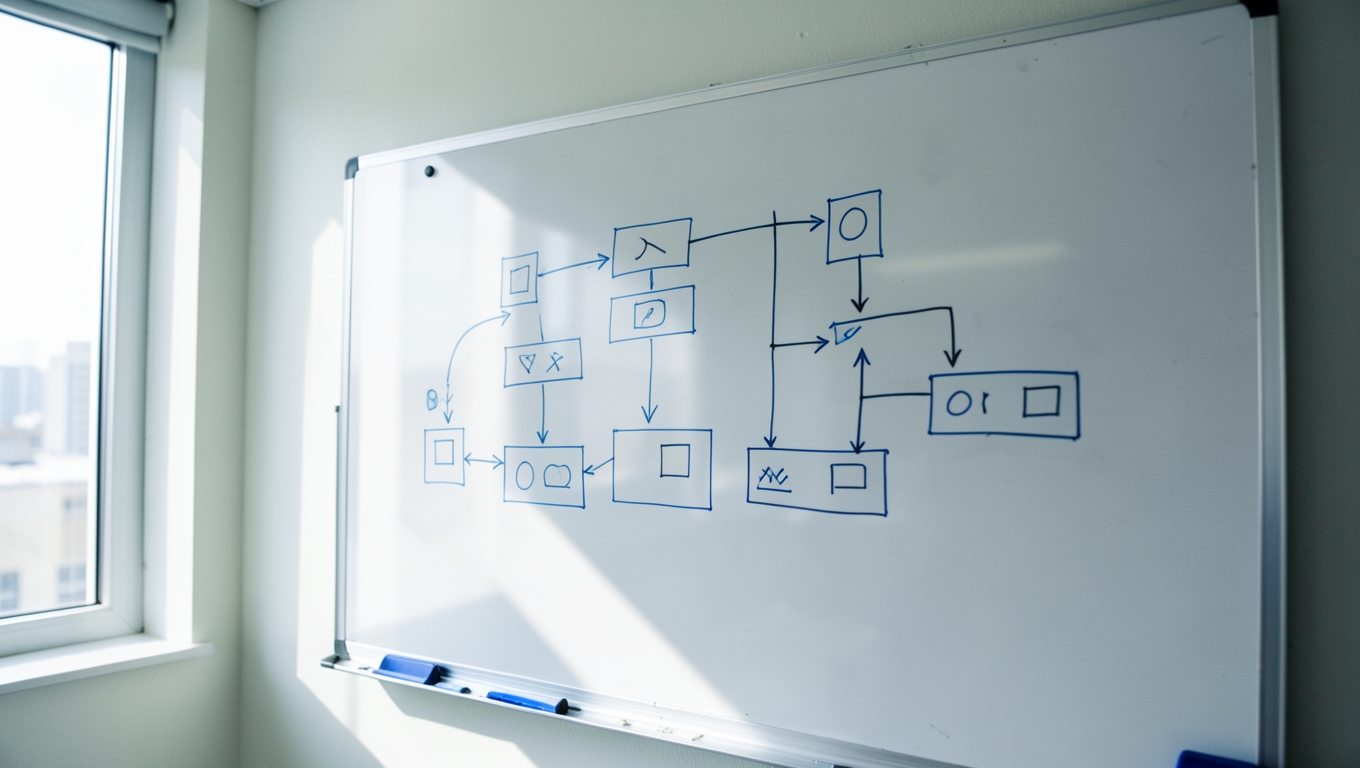
Before and after on a whiteboard: one process, two owners removed, four hours a week back.
This is about the order of operations: which processes to automate first, which to leave alone for now, what each approach costs in rands, and how to tell inside 90 days whether it worked. The World Bank and IFC report on the MSME opportunity in South Africa found that small enterprises employ 50 to 60 percent of the country's workforce and contribute around 34 percent of GDP, while only 14% of small businesses are formalised. An hour lost in a small firm is not a rounding error.
How much does manual admin actually cost a South African small business?
Sage's research with Plum Consulting, published as Sweating the Small Stuff, found that local small and medium businesses spend an average of 202 working days a year on admin tasks, which is 1,616 hours, or around 3.7% of total manpower. The study put the direct cost at an average of $39,000 (R532 801) a year, and estimated that a productivity improvement of 3.7% in South Africa could add at least R7.3 billion a year to GDP. Of the time measured, accounting took more than 20%, generating invoices 17% and processing invoices 13%. Most of that list is one activity in different clothes: copying information from one place to another.
Now do the arithmetic that matters, because a benchmark on a research page is not a business case. Take three admin staff on R18 500 a month each. That is R222 000 a year per person, and 2 160 paid hours across a 45-hour week and 48 working weeks, so a paid hour costs R103. Give the team back ten hours a week, modest for invoice chasing and document collection, and that is 480 hours across the year, or R49 440 at R103 an hour.
That is the conservative case. If each of the three gets two hours a day back, the team recovers 1 440 hours, or about R148 000 a year. Against a consultant-led programme at R60 000, the second case repays itself in under five months. Redo the sum with your own salaries and your own hours before you believe anyone, including this article.
You do not need a business case for automation. You need your own hours and your own salaries in the same sentence.
Which five processes should you automate first?
A good first candidate repeats often, has one obvious owner, and produces something a client can see. Five processes keep clearing that bar.
Quote to invoice. The same job details get typed into a quote, an email, a job card and an invoice. One form that produces all four removes the retyping and the typos that travel with it.
Invoice to payment follow-up. The first reminder is easy. The fifth, on day 45, is where small businesses leak cash. A scheduled sequence does not depend on anybody's mood.
Customer onboarding. Onboarding is a fixed list of documents, signatures and confirmations. What automation gives back is chasing time, not judgement time.
Job and stock tracking. If your team phones each other to ask where a job is, the fix is a status field that updates itself, not another report nobody reads.
The weekly management report. If Friday afternoon goes into assembling the same numbers by hand, you are paying a salary for a spreadsheet routine.
Table 1 compares them on volume, fit and payback. The cost bands are what a small Gauteng business typically pays in 2026.
Process | Volume and repeatability | Automation fit | Typical first-year cost | Expected payback |
Quote to invoice | Every job, daily | High: one form, standard documents | R15 000 to R45 000 | 3 to 8 months |
Payment follow-up | Every open invoice, daily | High: fixed, simple rules | R5 000 to R25 000 | 1 to 4 months |
Customer onboarding | Every new customer | Medium: needs clean customer data | R20 000 to R60 000 | 6 to 12 months |
Job and stock tracking | Continuous, multiple users | Medium: needs field phone use | R25 000 to R80 000 | 8 to 18 months |
Weekly management report | Once a week | High: the data already exists | R5 000 to R20 000 | 2 to 6 months |
These are boring projects, which is the point. Boring is measurable, and a win in month two buys the credibility to attempt something harder in month six. The pattern is familiar from digital transformation work in South Africa: sequencing decides the outcome more than the technology does.
Which projects are the wrong place to start?
Four categories cause most of the wreckage. Leave them for later.
Anything that needs the client to change first. If the automation only works when the customer uses the new portal, you have moved the problem, not solved it.
Payroll. BCEA obligations, leave and UIF all change, and the cost of an error is a dispute with an employee. Keep it in a proper payroll system.
Anything touching SARS submissions. The risk is statutory, not technical. Keep filing in sanctioned systems and use the SARS small business tax guide rather than a workflow you built on a Sunday.
Any process nobody can describe. If two people explain the same process differently, you are automating an argument.
If you cannot describe a process on one page, you cannot automate it. You can only make it faster at being unclear.
What does business process automation cost in South Africa in 2026?
There are four ways to buy this work, and they fail differently. An off-the-shelf workflow subscription runs from about R350 to R2 500 a month for a small team, and it is cheap until you need something it was never built to do. A bookkeeping or CRM migration sits at R15 000 to R60 000 once off. A custom build runs from R25 000 to R120 000. A consultant-led programme, where somebody maps the processes and manages the change, starts at R60 000. Some surrounding admin you can settle directly, including annual returns through CIPC.
Approach | What you are buying | Typical cost | Choose it when |
Off-the-shelf subscription | A standard tool, configured by you | R350 to R2 500 a month | The process is common and you can live with the tool's version |
Configured platform with a partner | A migration onto a standard bookkeeping or CRM system | R15 000 to R60 000 once off | Your data is messy and you want somebody accountable |
Custom build | Software written around your process | R25 000 to R120 000 once off | The process is genuinely unusual and gives you an advantage |
Consultant-led programme | Process mapping, sequencing, training and handover | From R60 000 | More than one process is involved, or the last attempt died |
The subscription was never the real cost. The hours you and your team put into making it work are.
The break-even logic is simpler than the pricing. A subscription pays for itself if it saves four to six hours a month at a loaded rate near R103 an hour. A once-off build at R45 000 breaks even inside a year at 480 hours, which is the ten-hours-a-week case above. A consultant-led programme has to return more than one process to justify itself, which is why it should be sequenced rather than bought as one heroic project. If your turnover is small, the turnover tax route also keeps filing obligations simple.
Why do load shedding, prepaid data and WhatsApp change the design?
Nedbank's research into load shedding in the township economy records the shift plainly: the country moved from 121 hours of load shedding in 2014 to over 3 773 hours in 2022, with more than 157 days of outages that year. Eskom publishes the national picture, but your team experiences it as an unscheduled pause in the middle of an afternoon. Treat the local constraints as design requirements.
Power. Anything that must run during an outage needs a battery-backed router and a phone-first fallback. If the automation stalls when the power goes, staff quietly go back to the spreadsheet.
Data. Prepaid data is a budget line for the person using it. Test every screen on a slow connection and a small screen; a tool that eats 200MB to confirm a delivery will not be used in Soweto.
WhatsApp. For many customers it is the only channel they answer. Design it as an input and an output rather than a side conversation that lives outside the system. Our WhatsApp marketing playbook for South Africa covers how those conversations start.
December and January. A November go-live is a bad idea: your team, your supplier and your clients all slow down at once. Automate the payment follow-up before the holidays.
Load shedding is a design requirement, not an excuse. If a process needs electricity and human attention at the same time, it will fail in Gauteng.
What breaks an automation after go-live?
Most failures are organisational, and they surface in the second month. The exceptions outnumber the standard case, so the tool becomes a second job for whoever was given it. Nobody owns it after handover, so it drifts. Staff were never told why the process changed, so they route around it and the old spreadsheet survives in a drawer. A key expires, the workflow stops silently, and you hear about it from a client.
Two more things belong on that list. Every automation inherits whatever mess sits upstream, so one source of truth for customers, one for jobs and one for money comes before anything clever. And if the automation collects ID numbers, contact details or documents, you are processing personal information. The Protection of Personal Information Act applies whether you employ ten people or a thousand, and the Information Regulator enforces it. Our note on POPIA compliance for small business covers consent, access control and a retention rule, designed in at the start rather than retrofitted later.
The market has already moved. Xero's 2026 State of South African Small Business report, which surveyed 427 small businesses, found that 85% are prioritising digital adoption and 44% are automating processes, while 62% had cash flow problems in the past year. The tools are no longer the differentiator. The order you fix things in is.
Once the invoicing and the follow-ups run themselves, the next candidate is usually judgement work: triage, first response, quoting from a library. That is where AI agents for small business start to make sense, and only after the data underneath them is clean.
A tool nobody was told about is a tool nobody uses. Tell the team what changes for them, not what changes for the software.
What should you measure in the first 90 days?
Pick three numbers before you start and put them where you will actually look at them. Do not measure satisfaction. Measure work.
Hours returned. The hours a week the team no longer spends on the automated step. Ask the person doing the work, not the dashboard.
Cycle time. Quote to invoice, or invoice to payment, measured in days.
Exception rate. How often a case falls outside the automated path. Above roughly one in five, the process is not ready.
Then run a 30 day starter rather than a project.
Days 1 to 5: write down one process exactly as it happens today, with the hours it costs. One page, not a workshop.
Days 6 to 10: fix the data it depends on. One list of customers, one of jobs, one of invoices.
Days 11 to 20: build the smallest version that removes the copying.
Days 21 to 25: run it alongside the old way and watch the exception rate.
Days 26 to 30: switch off the old way, name the owner, and write down what happens the next time it breaks.
Keep one number in view while you plan. FinMark Trust's FinScope MSME 2024 survey counted about 3 million MSMEs in South Africa employing around 13.4 million people, with 72% operating informally. Most of them have a WhatsApp account and no system at all. If you would rather have somebody walk the process with you before committing a budget, an AI readiness assessment costs less than a failed build, and it is the work we do from Johannesburg. See our services page, read related thinking on the blog, look at work we have published, check the about page, or get in touch.
Business process automation in South Africa: Quick Answers
How much does business process automation cost in South Africa?
Expect R350 to R2 500 a month for off-the-shelf workflow tools, R15 000 to R60 000 once off for a configured bookkeeping or CRM migration, R25 000 to R120 000 for a custom build, and from R60 000 for a consultant-led programme. The cost that surprises owners is their own time, so budget for it.
Which business process should a small business automate first?
Start with payment follow-up or quote to invoice. Both are high volume and rule-based, with an obvious owner and a visible result within weeks. A process that repeats daily is a better first project than one that runs once a month.
How long does an automation project take?
A single step usually takes two to four weeks if the data is clean and one person owns it. A programme covering three or four processes takes a quarter, and the sequencing matters more than the speed. Avoid launching in November.
Do I need a developer to automate my business processes?
Not for the first two or three processes. Most SME automation is configuration: connecting a form, an invoice and a notification inside tools that already exist. A developer earns the money when the process is genuinely unusual or gives you something competitors cannot buy off the shelf.
Is automation worth it for a business with fewer than ten staff?
Usually yes, on a narrow slice. With a small team, ten hours a week is a quarter of somebody's job, and that is the R49 440 a year in the worked example above. The common mistake is buying a broad platform instead of fixing one step properly.
How does POPIA affect automation that handles customer data?
If the automation processes personal information such as ID numbers, contact details or documents, the Protection of Personal Information Act applies to you. That means a lawful basis for processing, access control, a retention rule and the ability to answer a data subject request. Design these in at the start, because they are cheaper than retrofitting them later.
Automate the thing you would be embarrassed to keep doing by hand. Measure it for 90 days. Then choose the next one.


Comments